
Letters from Father
Ordinations - May 24, 2024
Dear Brothers and Sisters in Christ,
It was ten years ago today (May 24th) that my ‘nose hit the marble’, as the saying goes for those men who are ordained. The day was kind of a blur as some of you could probably attest about your wedding day. People have asked me what part of the ordination was most impactful. For some, it is when the bishop lays his hands on the head of the one to be ordained, which is the essential action in the ordination rite. For others it is when one’s hands are consecrated with Sacred Chrism. Still others say it is when they are welcomed into the fraternity of the priesthood by the sign of peace from all the priests present.
For me, it was at the beginning of Mass during the penitential rite when the choir sang “Lord have mercy.” This is because I recognize the great mercy of Christ who has called me, an unworthy sinner, to be His instrument of mercy to others. Knowing the reality of His infinite mercy, I wept, which is not a common occurrence for me. I give gratitude to God for the gift to participate in the priesthood of Jesus Christ and for the opportunity to serve such a wonderful parish at St. Peter Church.
This weekend Bishop Conley will ordain two men as transitional deacons and five men to the priesthood for the Diocese of Lincoln. One of those men, Deacon Santiago Izquierdo attended our Catholic school. He will have his first Mass at St. Peter Church on Sunday at 2pm. He is our fifth student from our school to be ordained in the past few years.
We are so blessed in our Diocese for the gift of many vocations to the priesthood. May we offer our prayers and support for the newly ordained priest. We should also pray for those places in the world that lack the number of priests to care for souls. I leave you with an exhortation to priest by Saint John Paul II,
“Think of the places where people anxiously await a Priest, and where for many years; feeling the lack of such a Priest, they do not cease to hope for his presence. And sometimes it happens that they meet in an abandoned shrine, and place on the altar a stole which they still keep, and recite all the prayers of the Eucharistic liturgy; and then, at the moment that corresponds to the transubstantiation a deep silence comes down upon them, a silence sometimes broken by a sob… so ardently do they desire to hear the words that only the lips of a Priest can efficaciously utter. So much do they desire Eucharistic Communion, in which they can share only through the ministry of a priest, just as they also so eagerly wait to hear the divine words of pardon: Ego te absolvo a peccatis tuis! So deeply do they feel the absence of a Priest among them!... Such places are not lacking in the world. So, if one of you doubts the meaning of his priesthood, if he thinks it is "socially" fruitless or useless, reflect on this!"
In His Mercy,
Fr. Eric Clark, Pastor
Gift of the Spirit - May 17, 2024
Dear Brothers and Sisters in Christ,
If you get the chance to go to St. Peter Basilica in the Vatican, you may notice the beautiful Dove of the Holy Spirit window in the back apse. It was created by Gianno Bernini in 1660 AD and is not stain glass but actually alabaster stone. The dove, from wing tip to wing tip, is six feet wide, which puts into perspective the colossal size of the whole sculpture. The light rays shift from brighter to darker as they move away from the dove, thus illustrating God the Holy Spirit as the source of light. The brightness alternates between light and dark with each division between the amber light rays around the dove, thereby accentuating each individual beam of light without bringing too much attention to any single one. Our stain glass window of the Holy Spirit above our altar is designed after this beautiful masterpiece.
This weekend we celebrated the feast of Pentecost. It was at the first Pentecost in which the Holy Spirit descended upon the Apostles and Mary in the upper room as tongues of fire. The fire of Divine love equipped them for the missionary endeavors.
The Holy Spirit is given to each of us as forms of different gifts so that we may give glory to God and build His Kingdom. “Whether extraordinary or simple and humble, charisms are graces of the Holy Spirit which directly or indirectly benefit the Church, ordered as they are to her building up, to the good of men, and to the needs of the world...It is in this sense that discernment of charisms is always necessary” (CCC 799,801).
“Each one has received a gift, use it to serve one another as good stewards” (1 Peter 4:10). We are a stewardship parish and every one of us is called by God to give back our time, talents and treasure. What are your spiritual talents, gifts, charisms?
Like other presents, it is impossible to fully appreciate and make use of our spiritual gifts until they have been discovered and opened. Let us discover our gifts together today so we may allow the Holy Spirit to work through us to help others and build God’s kingdom.
In His Mercy,
Fr. Eric Clark, Pastor
Mary Protector of Life - May 10, 2024
Dear Brothers and Sisters in Christ,
One thing I learned as a young boy out in the pasture is you do not get between the momma cow and her baby calf. Mothers have the instinct of protecting their children.
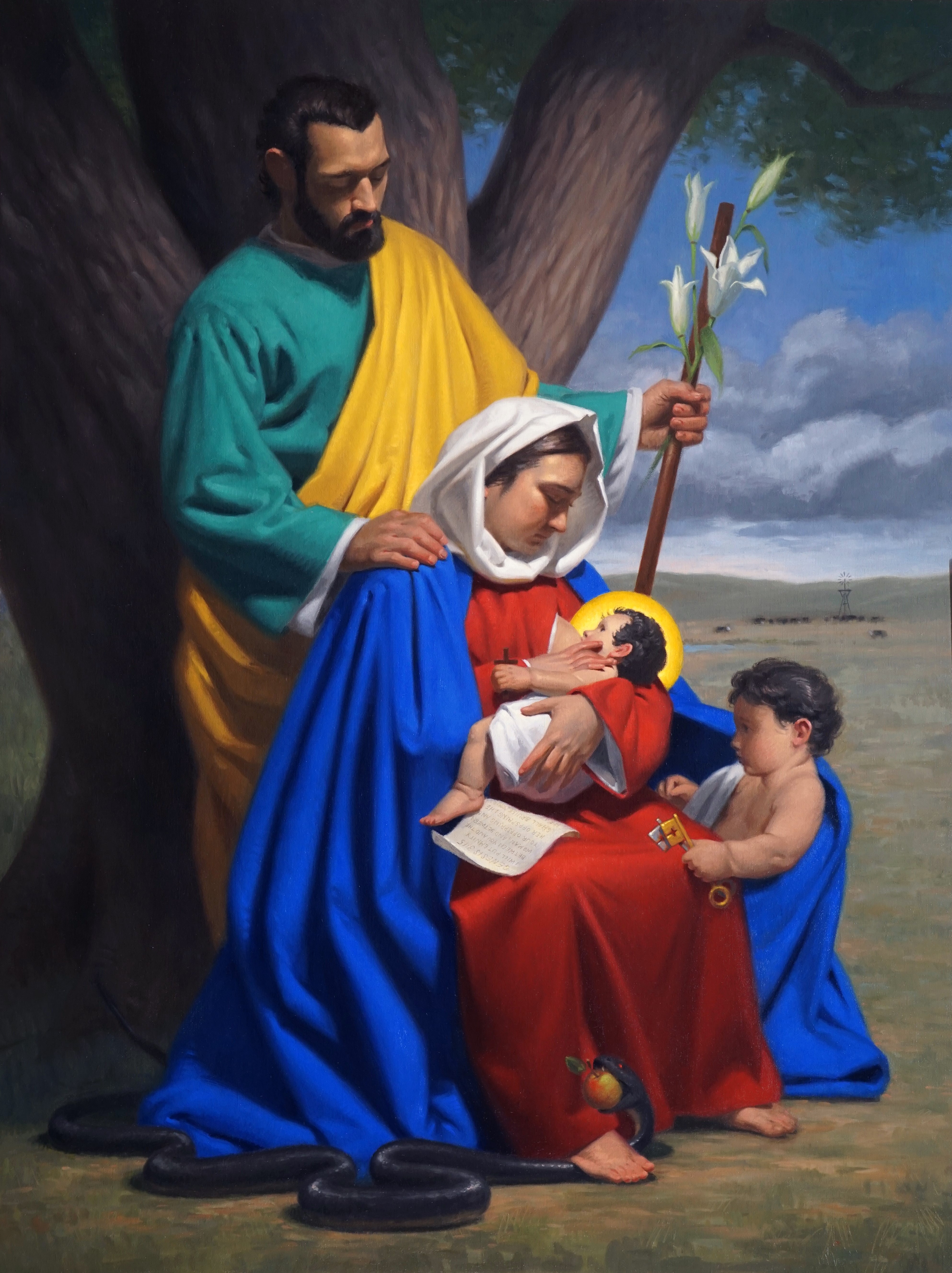
If you walk into our narthex, you will notice a new beautiful, commissioned painting entitled, “Our Lady, Protector of Life.” St. Mary is positioned under an eastern cottonwood tree with St. Joseph by her side. She protects both our Savior, Jesus and our patron, St. Peter under her mantel as the storms rage on a Nebraska prairie and the serpent is crushed under her foot as she reads from the prophecy Genesis 3:15, “He will strike at your head while you strike at his heel.”
I wish all mothers in our parish and especially my mom, a happy Mother’s Day. Thank you for your protection of life! And thank you Mother Mary, who has protected the Author of Life, Jesus and His disciples.
In His Mercy,
Fr. Eric Clark, Pastor
Charity & Stewardship Appeal - May 3, 2024
Dear Brothers and Sisters in Christ,
As you walk into our newly remodeled church, you will see twelve figures from the Old Testament on your left. The second to last figure is the beautiful Queen Esther. She was called by God to save her Jewish people from being destroyed in Persia. Her foster-father and uncle, Mordecai strengthens her by exclaiming that she was made “For such a time as this” (Esther 4:14).
Often times we may be tempted to believe it would be better if we were living in different times. Or if we had the perfect job, house, family, etc. But we are made “for such a time as this.” And now is the time to give of ourselves out of love.
With these images in mind, I am excited to begin another year of the Charity and Stewardship Appeal. This year’s theme is “For such a time as this.”
As you know, the annual Charity and Stewardship Appeal supports ministries and offices of the entire diocese. And each of these seeks to live the commandment of Jesus by loving one another as we hear about in this weekend’s Gospel (John 15:12). The Family Life Office, for example, seeks to love what God intends in marriage and family life. Likewise, Catholic Social Services brings forth the deeds of love by outreach to the poor and suffering. Similarly, the diocese cultivates the love of truth through the Evangelization Office and, in a special way, through our many Catholic schools. Last year, our parish generously pledged $192,000, of which 89% was returned to St. Peter Church. Our parish goal this year is $200,000 with $27,670 going to support different ministries in the Diocese.
This year, I ask every household to love one another by generously supporting the Charity and Stewardship Appeal. All of us are called to love, in one way or another, and to be generous stewards of our gifts.
Brothers and sisters, together may we become the disciples God has called us to be because we were made for this time. Thank you and may God abundantly bless you and reward your generosity a hundredfold.
In His Mercy,
Fr. Eric Clark, Pastor
Our Lady of Good Counsel - April 26, 2024
Dear Brothers and Sisters in Christ,
If you travel about thirty miles south of Rome, Italy you will stumble upon the church of Santa Maria run by Augustinian monks. This church was established in the 5th century in the town of Genazzano. It was the financial contributions of people from this village that were given to Pope Sixtus III to build the magnificent Basilica of Santa Maria Maggiore in Rome, which is one of the four major basilicas in the world.
According to tradition, the story is said to have begun in 1467. By then the little church of Santa Maria in Genazzano was in dire need of repair and lacked funds to repair it.
In the midst of the festivities for the feast of St Mark (April 25th), the townsfolk suddenly heard “heavenly music.” A mysterious cloud was then said to have descended on the unfinished wall of the parish church. In front of the people, the cloud dissipated and a beautiful fresco, no more than eighteen-inch square, of the Virgin Mary and the Christ Child was revealed. It was widely believed that it had been miraculously transported from a church in Albania just prior to its invasion by Muslims.
The picture of Our Lady is called Our Lady of Good Counsel and today (April 26th) is her feast day. It was this image that was the favorite Marian image of great leaders in the church such as St. Aloysius Gonzaga, St. John Bosco, St. Alphonsus Liguori and Pope Pius XII.
Our vision statement at St. Peter Church, “Abide in Christ & build His Kingdom” is taken from our Gospel this weekend. Our Lord says, “I am the vine, you are the branches. Whoever remains in me and I in him will bear much fruit, because without me you can do nothing” (John 15:5).
In order to abide in Christ, I encourage each one of our parishioners to prayerfully consider spending a weekend in prayer and relaxation at Our Lady of Good Counsel Retreat House. Since we value your spiritual journey, our parish will help fund half of the retreat expense for active parishioners. Please take advantage of this opportunity to draw near to God.
“O Mother of Good Counsel, obtain for us from your Divine Son a great love of virtue, and, in the hour of uncertainty and trial, the strength to embrace the way that leads to our salvation. If your hand sustains us, we shall walk peacefully along the path indicated to us by the life and words of Jesus, our Redeemer; and having followed freely and securely, even in the midst of this world's strife, the Sun of Truth and Justice under your maternal Star, we shall come to the enjoyment of full and eternal peace with you in the haven of salvation.” - Pope Pius XIII
In His Mercy,
Fr. Eric Clark, Pastor
Good Shepherd - April 19, 2024
Dear Brothers and Sisters in Christ,
The famous modern artist Pablo Picasso was born into a Catholic family in 1881. But he rejected his Catholic upbringing in his early 20s, mostly because he saw religious morals as an obstacle to the hedonistic fashions of his age. Picasso never publicly returned to the Church, although a priest was present at the artist's funeral. Throughout his life, he associated himself with various secular movements, one of them being communism, a violently anti-Christian ideology.
Soon after Picasso became a communist, he made an interesting sculpture called "Man with Sheep." It was a conscious re-interpretation of a famous and beloved image in Christian art, one we are all familiar with because it is taken directly from the Gospels - the good shepherd.
In traditional sculptures and paintings of the good shepherd, a tranquil lamb curls gently around the shepherd's shoulders. This is how shepherds used to teach rambunctious and foolish lambs that would run off on their own and leave the flock. The shepherd would break one of the lamb's legs, so that it couldn't run off into danger, and then carry the wounded lamb for weeks, until it healed. By that time, the lamb would have learned that the shepherd is good and trustworthy, and so it would never again stray away from the shepherd into danger.
Picasso's "Man with Sheep" is a complete contrast. In this bronze sculpture, the shepherd is a stark, distorted man with the bulging eyes and a fierce expression. He clasps the sheep in one arm, while the animal twists its head away, open-mouthed and protesting, resisting with all its might. Picasso's figure seems like a butcher bringing a lamb to the slaughter.
That's what happens when we try to understand suffering without Christ - it just doesn't make sense. But with Christ, all our crosses bring salvation, wisdom, and deeper intimacy with God.
This weekend we celebrate Good Shepherd Sunday. It is a weekend set aside in the Church to pray and encourage vocations to the priesthood. In the Gospel, Jesus says “I am the good shepherd. A good shepherd lays down his life for the sheep” (John 10:11).
I encourage parents, grandparents and friends to support the young men in our parish to lay their life down for God’s flock by being a priest. One of the best ways to inspire future vocations to the priesthood is by attending Mass together as a family and encouraging our young boys to serve at the altar.
May we continue to pray, foster and support these boys and young men to hear the voice of God calling them to follow Him so that they may one day lead God’s flock into the verdant pastures of Heaven.
In His Mercy,
Fr. Eric Clark, Pastor
A Holy Headache - April 12, 2024
Dear Brothers and Sisters in Christ,
St. Aspren's intercession is invoked for headaches. The connection to the medicine may sound like a stretch but read on and decide for yourself.
Tradition has it that St. Peter, passing through Naples on his way to Rome, met an elderly woman named Candida who was very ill. The apostle, in the name of Jesus Christ, cured her. After thanking him for the miraculous healing, the woman asked Peter to intercede for the healing of a friend of hers, Aspren, who was also ill. Both Candida and Aspren, after being healed, converted to the faith and were baptized.
Before St. Peter left for Rome, he left St. Aspren in charge of the church of Naples; he was the first bishop of the city and remained in office for 23 years. The staff with which Peter is said to have cured Aspren is preserved there in the Royal Chapel of Naples.
There are two probable reasons why his devotees attributed to the saint the ability to cure headaches. One is due to the fact that he was beheaded for refusing to deny the faith. The other is that he was known for doing penance by putting a stone on his head.
It was the German pharmaceutical company Bayer that released Aspirin and named it in 1899. The official explanation given for the name is that “the ‘A’ comes from acetyl and ‘spir’ from the first part of Spirea ulmaria, a botanical source of salicylic acid.” That might seem to debunk the theory. However, it’s also possible that someone at Bayer wanted to reference St. Aspren and found a way to justify doing so by referencing more mundane, scientific reasons.
We’ll probably never know the full truth. In the meantime, if you suffer from headaches, we can pray to St. Aspren, and if the headaches don’t go away, there is always Aspirin!
In His Mercy,
Fr. Eric Clark, Pastor
Breath of God - April 5, 2024
Dear Brothers and Sisters in Christ,
As one takes a break from the toils of every day ordinary life and enters into prayer and conversation with God through praying midday prayer in the Liturgy of Hours, one may encounter the hymn entitled, “Breathe on me, O breath of God.” This beautiful hymn was composed by the nineteenth century Englishman named Edwin Hatch.
Although it is human-like for God to breathe, “A breath is the most immaterial realty we perceive,” as St. John Paul II wrote. The breath of God is the immaterial spirit which animates life in the soul. St. Thomas Aquinas furthers this point by stating, “The term ‘breathe’ is not to be taken in the material sense, but as regards the act of God, to breathe (spirare), is the same as to make a spirit.”
The etymology of breath comes from the Hebrew word ‘rauch’ (רוּח) or ‘nesamah’ (נשׁמה), which can be translated into – breath, wind, or spirit. The word nesamah is used in the creation account. However, the terms ruach and nesamah are used synonymously as shown in the book of Job.
This weekend we hear about Jesus breathing on the Apostles. After Jesus conquered sin and death on the cross, He imparted the mission as well to His apostles to forgive sins and bring about new spiritual life. “He breathed on them, and said to them, ‘Receive the Holy Spirit. If you forgive the sins of any, they are forgiven; if you retain the sins of any, they are retained” (John 20). Jesus restored the grace of humanity by granting the apostles the breath of God. The breath of God is the authority to forgive sins and renew life in the soul. Christ bestows the gift of the Holy Spirit upon the Apostles and the Church so that they may continue the “great work of creating a new race of men.” Thus the divine eschatological creation through the breath of God is a transformation of the initial creation in the garden.
The action of God breathing life into the nostrils of Adam and installing life into the dry bones are events foreshadowing the breath of God granted in the sacrament of confession. The Greek word ‘he breathed’ (ἐνεφύσησεν) is the same word used in both Genesis and John. The Holy Spirit is breathed into humanity during the sacrament of reconciliation in order to renew in the soul the original image and likeness to the Creator. It should be noted that the effects of sanctifying breath of God in this sacrament is a far greater event than the breath of God during creation. The reason is because the sanctified soul is eternally glorified while creation will pass away.
If we find ourselves spiritually dead to eternal life by our sins, may we allow Him to do spiritual CPR and breathe new life into our souls.
In His Mercy,
Fr. Eric Clark, Pastor
The Cross - March 29, 2024
Dear Brothers and Sisters in Christ,
A few weeks ago, I was over at a new parishioner’s home for dinner and a house blessing. They shared with me the story about how their Protestant grandson who was about 6 years old was enthralled with their crucifix. He was not used to seeing Jesus on the cross, as is accustom in the Protestant world. He then came to the realization of what the cross meant and why Jesus was on it.
One reason the cross is so hard to understand is that we were not created to live in a fallen world. This is why St. Paul wrote, For Jews demand signs and Greeks look for wisdom, but we proclaim Christ crucified, a stumbling block to Jews and foolishness to Gentiles (1 Cor. 1:22-23).
We were created to live in a world where justice, truth, and peace were the norm. But after original sin, injustice, ignorance, and strife have become our daily bread. And so, in our hearts we know this is not the way it's supposed to be.
But then we make the mistake of thinking that it's up to us to make everything right. It isn't. We need a Savior. We don't take away the sin of the world; the Lamb of God takes away the sin of the world. And he takes it away with his cross. By letting us share in his cross, in his suffering and sorrow, he gives us a chance to share in his work of salvation, and to prove that we love the giver of all good gifts (God) better than the gifts.
This is why all the saints love and embrace the cross. St Margaret Mary Alacoque, who received the revelations of the Sacred Heart of Jesus, put it like this: "Trust to the goodness of our Lord in the crosses which He sends you; He will never abandon you, for He knows how to draw good from our ills and His glory from our trials…. What should I do, had I not a cross to bear? ...It is my whole treasure in the adorable Heart of Jesus Christ, and there it is the cause of all my happiness, my delight and my joy."
Sharing in Christ's cross helps purify our hearts of selfishness. And the less selfishness we have in our hearts, the more room for Christ's love - the true source of lasting joy, wisdom, and peace.
In His Mercy,
Fr. Eric Clark, Pastor
Paradox - March 15, 2024
Dear Brothers and Sisters in Christ,
The ancient Greek philosopher Socrates famously said, “I know one thing, that I know nothing.” This is what we call a paradox. This word is a Greek word that literally means, distinct from common opinion.
In the Gospel this weekend, Jesus proclaims a paradox. He uses an analogy of wheat. “Amen, amen, I say to you, unless a grain of wheat falls to the ground and dies, it remains just a grain of wheat; but if it dies, it produces much fruit” (John 12:24). Wheat is one of the most abundant and versatile food crops in the world. Each wheat plant can produce 110 other wheat plants. The death of a wheat stock produces a multitude of others.
It is always because great men have been prepared to die that have allowed others to live, for instance the freedom of our country. Only by spending life do we actually gain life. The world owes everything to people who recklessly spent their strength and gave themselves to God and to others. Yes, we live in a world of finite goods, but we are made for a world of infinite goods.
Only a human being would ask, “How can someone who loves himself deny himself?” God … says to such a person, “Let him deny himself, if he loves himself.” By loving himself, you see, he loses himself; by denying himself, he finds himself. “Whoever loves his soul,” he says, “let him lose it.”…It is a painful thing to lose what you love.
St. Augustine says, “There is not anyone, after all, who does not love himself. But we have to look for the right sort of love and avoid the wrong sort. You see, anyone who loves himself by leaving God out of his life (and leaves God out of his life by loving himself), does not even remain in himself. He actually leaves his self. He goes away into exile from his own heart by taking no notice of what is inside and instead only loving what is outside…”
Jesus came to the Jews with a new view of life. They looked on glory as conquest, the acquisition of power, the right to rule. He looked on glory as a cross. “When I am lifted up, I will draw all men to myself” (John 20:33). Jesus taught us that only by death comes life; that only by spending life do we retrain it; that only by service comes greatness. This is the paradox of Christianity. Today, may you and I become more like Jesus Christ, a paradox to the world but a glory…to the name of the Father!
In His Mercy,
Fr. Eric Clark, Pastor
Rejoice - March 8, 2024
Dear Brothers and Sisters in Christ,
It is the time of year for state basketball. One joyful thing about the tournament is watching the student sections with their school spirit. These energetic youth show their school unity and support by wearing similar colors or choosing a theme for each game.
Our theme for Mass this weekend is joy, and our color is pink. Actually, the term is liturgical rose. The 4th Sunday of Lent is called Laetare Sunday. Laetare is the Latin word for rejoice, which comes from the entrance antiphon at the Mass, “Rejoice, O Jerusalem, and all who love her. Be joyful, all who were in mourning…” (Isaiah 66:10-11).
In the days of the Prophet Isaiah, the Jewish people had many hardships. These sufferings were the consequence of turning their hearts from God. The indictment of the chosen people by Isaiah would culminate in the destruction of Jerusalem and their exile from the Promised Land into the pagan territories.
The book of Isaiah ends on a happy note. Eventually the children of God repented, and He saved them from their enemies and restored them to their homeland. Their return to worship in Jerusalem led the Jewish nation to rediscover joy.
I know it has been a challenge the last ten months having Mass in Bishop Vasa Hall, but we still have much to be joyful for because God has not abandoned us. He is with us in our families as we pray together. He is with us substantially in the flesh of Christ at each Mass. And today, we can rejoice, for in two weeks, we will be in our renovated church.
Brothers and sisters, to rejoice is to rediscover joy, a joy that can be rediscovered amid the sufferings of Lent, a joy this world cannot give nor contain. This joy can only be found in giving your heart to Jesus Christ.
In His Mercy,
Fr. Eric Clark, Pastor
PS – I look forward to seeing your Christian spirit in your Sunday-best ‘pink’ this weekend!
Indifference - March 1, 2024
Dear Brothers and Sisters in Christ,
Imagine if your home parish of St. Peter became a place of commerce. Bishop Vasa Hall became a barbeque restaurant, the narthex a place to sell nick-nacks, the sacristy was a hair salon, and the church became a recital hall. This seems tragic and almost blasphemous to our minds but a sad reality of the fate of many parishes in Europe.
In the Gospel this weekend, we encounter our Lord, who went into the Jewish Temple to pray but found it a marketplace. With zeal and love for His Father’s house, he drove those sacrilegious people out.
I cannot imagine one would walk into the temple one day and set up a business unless they slowly grew cold to the love and law of God. What would cause someone to lose their piety, which is the reverence owed to God? Dare I say indifference?
Indifference is one of the greatest sins of our day because it leads us to become apathetic to the goodness we are created for. The ancients called this acedia, which means the absence of care. When we fail to care for God, His house, or His people, culture is thrown into the chaos of hell.
In a peculiar way, the suffering of Jesus is greater by those who are indifferent to Him than by those who directly attacked the Lord on His path to Calvary. This is what the British poet, Geoffery Studdert Kennedy meant when he wrote,
When Jesus came to Golgotha, they hanged Him on a tree,
They drove great nails through hands and feet, and made a Calvary;
They crowned Him with a crown of thorns, red were His wounds and deep,
For those were crude and cruel days, and human flesh was cheap.
When Jesus came to Birmingham, they simply passed Him by.
They would not hurt a hair of Him, they only let Him die;
For men had grown more tender, and they would not give Him pain,
They only just passed down the street, and left Him in the rain.
Still Jesus cried, ‘Forgive them, for they know not what they do,’
And still it rained the winter rain that drenched Him through and through;
The crowds went home and left the streets without a soul to see,
And Jesus crouched against a wall, and cried for Calvary.
For this Lent, may we be shaken from our indifference and begin to revere the God of love once again.
In His Mercy,
Fr. Eric Clark, Pastor
Glory and Pain - February 23, 2024
Dear Brothers and Sisters in Christ,
You may have never heard of Wilma Rudolph, but her story is remarkable. She was born in Clarksville, TN, on June 23, 1940. From the moment of her birth, she had the greatest disadvantages life could throw. She was born prematurely and into severe poverty because she had twenty-one siblings. She was an African American woman and, in those days, did not have the same equal rights as today. If those obstacles were not enough, she contracted polio and could not walk until she was twelve years old.
Even though Wilma had many crosses in her life, she did not let that slow her down, literally. At age twenty, eight years after she learned to walk, she won three Olympic gold medals in the 1960 Summer Olympics. She earned the title of “the fastest woman in the world.” Wilma Rudolph became a champion because her pains in life did not limit her from achieving glory.
If you knew you would win a gold medal, would you endure the pain? I believe most of us would say ‘yes’. Lent is a time to remind us of pain. The pain of sacrifice. The pain of fasting. But most importantly, the pain of our Lord Jesus.
But pain without purpose is pointless. This is why in the Gospel, this weekend, Jesus reveals His transfigured glory to the apostles.
The account of the Transfiguration is read during Lent for two reasons. First, to remove the discouragement of pain. St. Bede once wrote, “By His loving foresight, Christ allowed the disciples for a short time the eternal joy so that they might bear persecution bravely.” By showing us His glory, Jesus gives us the courage to carry our cross and follow Him.
Secondly, the Transfiguration of the Lord gives us hope by knowing our eternal end. An archer does not shoot an arrow straight unless he first sees the target. Jesus is revealing to us that He is God and humanity will be glorified through Him as long as we keep our eyes focused on Him.
St. Paul in his letter to the Corinthians said, “Run so you may win! Every athlete exercises self-control in all things. They do it to receive a perishable wreath, but we are imperishable.” May we become like Wilma Rudolph and never allow physical, emotional, or spiritual pains and weaknesses to discourage us from running the race toward eternal life.
In His Mercy,
Fr. Eric Clark, Pastor
Repent and Believe - February 16, 2024
Dear Brothers and Sisters in Christ,
If you are like me and the 126 million other Americans, you saw the Super Bowl this past Sunday. Whether you liked the outcome of the nail-biter game or not, we can all admit it was one for the ages.
But it was not the game that had my mind racing late Sunday night. It was the commercial entitled “Foot Washing” which aired during the first quarter of the game. It showed various still images of people – including a woman outside an abortion clinic and a transgender person – having their feet washed. It ended with the slogan: "Jesus didn't teach hate. He washed feet."
Of all the 2024 Super Bowl ads, The Washington Post branded the "He Gets Us" campaign as "most controversial." According to the Post, the ads were meant to "promote the teachings of Jesus and unite different groups of people. But perhaps unsurprisingly, all they’ve done is foment hostility."
So why this hostility? There are certain Christian ecclesial communities that thump the bible over people’s heads and tell them they are going to hell if they don’t act like them. On the other side, you have Christians who proclaim a version of Christianity in which everything goes because sin does not exist.
This hostility was the same in the days of the Lord. The Pharisees were self-proclaimed righteous observers of the law, while the Sadducees bought into the secular culture and watered down their faith. Both were a wrong approach to the covenant God made with His chosen people.
So, as true Christians, how are we to respond to others? We cannot condemn sinners, like the Pharisees, nor condone sinning like the Sadducees. The Pharisees would not stoop down to the level of a sinner to wash their feet. Sadducees would not believe it was necessary to wash feet because they were ok with their filth. But as a disciple of Jesus, we are called to have compassion by washing the feet of one another.
How do we do that? The answer lies in the Gospel this weekend, “Repent, and believe in the Gospel” (Mark 1:15). This powerful teaching of Jesus shows us two things: 1. He meets everyone where they are at, all of our brokenness, shame, and sins; but 2. He calls us to leave that behind by repentance. And that is the Good News!
So yes, “He Gets Us” but loves us too much to leave us there.
In His Mercy,
Fr. Eric Clark, Pastor
Leper - February 9, 2024
Dear Brothers and Sisters in Christ,
In the Gospel this coming weekend, we hear about the leper who came to Jesus for healing. Hansen’s disease, also known as leprosy, in the time of Christ was an untreatable disease that caused oozing sores, loss of limbs, and even blindness.
This poor leper not only had physical pain but the emotional loss of being cut off from society. Lepers were outcasts who had to shave their heads, tear their garments and yell out ‘unclean; unclean’ so as to not touch other people.
Furthermore, lepers experienced a deep spiritual agony because they were cut off from worship in the temple. Their disease was looked upon as a consequence of sin, thus making them ritually impure. However, that did not stop him from coming to Jesus. He did not let any pain (physical, social, or spiritual) separate him from God. Rather, he kneels and begs Jesus, “If you wish, you can make me clean.” This leper recognized Jesus is not just a physician and healer of the body but that He is God who could restore him to be able to worship once again.
Next week, we begin the season of Lent. Lent is a time to encounter the healing touch of Christ. We may not have physical leprosy, but each one of us has sin. Sin is leprosy in our soul that causes spiritual and emotional pain that separates us from God and others. We are all poor beggars in need of the riches of God’s restorative power.
Jesus Christ is not afraid to enter into our culture of pain and into our lives to extend His healing hand to take away our spiritual leprosy. However, He can only do that if we come to Him, kneel down before His mercy, and beg, “Lord, if you wish, YOU can make me clean.”
In His Mercy,
Fr. Eric Clark, Pastor
Presentation - February 2, 2024
Dear Brothers and Sisters in Christ,
Today is Groundhog’s Day. Punxsutawney Phil may or may not have prophesized the end of winter. Let’s hope that little varmint brings us some warmth soon.
Today is the commemoration of an important prophecy as we celebrate the Presentation of our Lord in the temple. This glorious event fulfills the prophecy of Malachi 1 in the Old Testament. The prophecy that Simeon in the Gospel Luke proclaimed was threefold. First, Jesus would be a light to the nations, the glory of Israel, and a sign of contradiction (Lk. 2:39-35).
Jesus was presented in the temple of Jerusalem to fulfill the Jewish law of redeeming, buying back the child with the price of a pair of turtledoves. The temple was called a light to the nations because it was set on top of a hill adorned with gold and jewels that shimmered at night from the light of the candles. However, Simeon told Mary and Joseph that Jesus was to be a light to the nations. This is why this feast day is the traditional feast day of blessing candles.
Second, the glory of Israel was the Ark of the Covenant. This was God’s dwelling place with the chosen people of Israel. However, it was captured by the Philistines and his people sat and wept. But the prophet Isaiah said it would return someday. Simeon, guided by the Holy Spirit, recognized that God’s presence and glory had returned in the person of Jesus.
Finally, Simeon also prophesized Jesus would be a sign of contradiction and Mary’s heart will be pierced with a sword. Christ was a contradiction for the 1st-century Jews and Romans alike. He is still a contradiction in our secular world today as He told us, “You will be hated by everyone because of my name” (Mat. 10:22).
Jesus was presented in the temple on earth so you and I could be presented in the temple of heaven. By our baptism, may we be a light to the nations, confirmation of the glory of God’s Church, and our reception of Eucharist this weekend as a sign of contradiction to the world.
In His Mercy,
Fr. Eric Clark, Pastor
Catholic School & Discipleship - January 26, 2024
Dear Brothers and Sisters in Christ,
This past week, I gave the State of the School address. I am filled with gratitude to all our parishioners, parents, teachers, and staff who make our school an awesome place to learn and become a disciple of Jesus Christ.
Our Catholic school is not just an excellent place for academic excellence and athletic achievements, but a place to develop artistic beauty. Our Catholic school is a place of discipleship. Disciples not only follow the Lord but accompany others on the clear path of discipleship.
Today is the feast day of Saints Timothy and Titus. Timothy was a non-practicing Jew who met St. Paul in the Roman city of Lystra (modern-day Turkey). Timothy converted to Christianity and became a disciple of Paul in Greece and Macedonia. During one of their missions, Timothy became sick to his stomach, so St. Paul encouraged him to “have a little wine for your illness” (1 Tim. 5:23). Raise your wine glass in honor of St. Timothy!
Titus was a Greek from Crete, who is said to have studied Greek philosophy and poetry in his early years, which allowed him to pursue truth and beauty. He was converted by Paul, whereupon he served as Paul's secretary and interpreter. In the year 49, Titus accompanied Paul to the council held at Jerusalem.
In St. Paul’s letter, he wrote, “What you heard from me through many witnesses entrust to faithful people who will have the ability to teach others as well” (2 Tim. 2:2). It is not enough for us to live the faith or even teach the faith. We must teach teachers, to teach the faith. This is how discipleship works.
And I, for one, am excited to participate in the work of the Holy Spirit making disciples in our parish!
In His Mercy,
Fr. Eric Clark, Pastor
World is passing away - January 19, 2024
Dear Brothers and Sisters,
During the Spanish Civil War, which began in 1935, the truth of our faith enabled many Catholics to show great heroism in the face of persecution.
An example of this was a priest, placed against a wall at the favorite execution spot in the Casa de Campo. As they stood him up before the firing squad, the padre pulled out his watch and, with a smile and a twinkle in his eye, said to the riflemen: "This is all I have; I bequeath it to the one who proves himself the best shot." The young rebel soldiers were so impressed by this old priest's calm and courageous humor that they lowered their rifles and ordered the priest to go free - with his watch.
In our second reading for this weekend, St. Paul writes to the church of Corinth, “I tell you, brothers, the time is running out…. For the world in its present form is passing away.” Time for that courageous priest was numbered, but his quick wit and valor at the sight of death granted him more time.
This coming Monday, we remember the unborn babies who died tragically in our country due to the scourge of abortion in our land. I am so grateful for the many parishioners who pray at the abortion chamber throughout the week. You are the voice for the voiceless and a source of hope for mothers. I encourage all the parishioners to join us in prayer for the unborn. I see this parish as a beacon for the unborn. We are called to be prophets like Jonah in this weekend’s 1st reading to call our nation to repentance!
If we become heroic for life in the face of persecution, those innocent babies will have the time each one of us longs for.
In His Mercy,
Fr. Eric Clark, Pastor
What are you looking for? - January 12, 2024
Dear Brothers and Sisters in Christ,
One of the greatest songs of all time is “I Still Haven’t Found What I’m Looking For.” The lead singer of U2, Bono, is looking for more to life and allows us to ponder “What are you looking for?” This is the perennial question that has been asked throughout history.
The Egyptians were looking for gods who were in control of nature. The Greeks were looking for truth in their study of philosophy, while the Romans were looking for peace for an Empire brought on by military conquest. And the Jews were looking for the long-anticipated Messiah.
In the Gospel this weekend, Jesus asks the Jewish people, “What are you looking for?” Jesus did not ask this out of ignorance but rather to give them an occasion to trust Him. Jesus says, “Come after me and you will find the answers to what you are looking for.”
There is one fundamental question our Lord asks each of us today, “What are you looking for?” I believe the human soul desires and is looking for three things: adventure, success, and romance. The great sinner turned saint, St. Augustine of Hippo wrote, “To seek God, is the greatest adventure; to find Him, the greatest success; & to fall in love with Him… the greatest romance.”
How can we practically look for God today? We can seek Him by reading the scriptures, find Him in daily prayer, and fall in love with Him in the sacraments. Today, if you are like Bono and “still haven’t found what you are looking for,” Jesus invites you to “come and see” Him at Mass this weekend.
In His Mercy,
Fr. Eric Clark, Pastor
Epiphany Blessing - January 5, 2024
Dear Brothers and Sisters in Christ,
A few years ago, someone asked me about the “graffiti” above my door. Maybe you have also wondered who has been writing in chalk above the doors to our church or parishioners’ homes.
This is the Epiphany blessing, done at the beginning of the year. This Christian custom of chalking the door has a biblical root. The Israelites in the Old Testament marked their doors with the lamb’s blood on the night of the Passover. “And they shall take of the blood thereof, and put it upon both the side posts and on the upper door posts of the houses, wherein they shall eat it.” (Exodus 12:7)
Using blessed chalk, the head of the household or a priest will mark the main door of the house with the initials of the Magi, the legendary names of the three kings: Caspar, Melchior, and Balthasar, and a code of the current year (2024) connected with crosses: 20 ✞ C ✞ M ✞ B ✞ 24. Another explanation of the initials (C ✞ M ✞ B) is the first letters of the blessing: “Christus Mansionem Benedicat” (Latin: “May Christ Bless this house”). The crosses (✞) represent the protection of the Christ. This short liturgy is a way of marking our homes with sacred signs and symbols as we ask God’s blessing upon those who live, work, or visit throughout the coming year.
The final prayer of the blessing is, “Lord God of heaven and earth, you revealed your only-begotten Son to every nation by the guidance of a star. Bless this house and all who inhabit it. Fill us with the light of Christ, that our concern for others may reflect your love. We ask this through Christ our Lord. Amen.” (USCCB).
In His Mercy,
Fr. Eric Clark, Pastor
PS – Please feel free to take some blessed chalk home with you after Mass this weekend. The Epiphany blessing can be found in the bulletin and on our website.
